
Maths Explore

Mechanical · sample calcsheet · 4 pages

Geared motor driving a winch

Sizing the electric motor of a winch that lifts a load through a single gear stage: the torque to accelerate the load and both shafts, the steady lifting power, and a check against a candidate motor. Based on example 12.2 from Design Engineer's Handbook (Richards, K.).
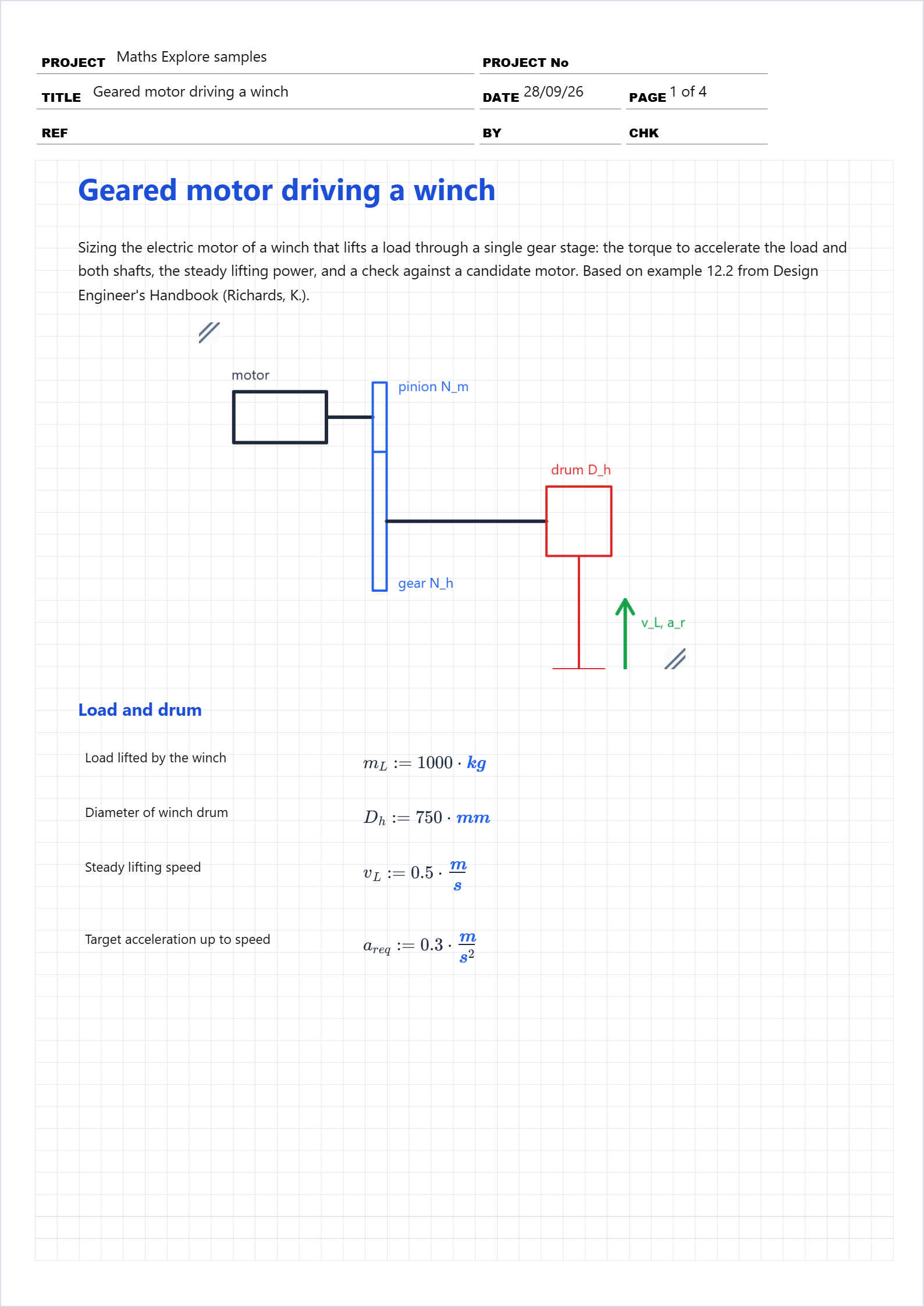
First page of the Geared motor driving a winch sample calcsheet in Maths Explore
The first page of the calcsheet as it appears in Maths Explore.

What this calculation covers

Load and drum

  • Load lifted by the winch
  • Diameter of winch drum
  • Steady lifting speed
  • Target acceleration up to speed

Machine and gearing

  • Mass of motor shaft assembly
  • Motor shaft radius of gyration
  • Mass of drum shaft assembly
  • Drum shaft radius of gyration
  • Number of teeth on the motor gear
  • Number of teeth on the drum gear
  • Gear stage efficiency
  • Gear ratio (drum rev per motor rev)

Lifting force and drum torque

Two demands to keep apart: holding-and-lifting at constant speed takes gravity only; getting up to speed briefly adds the acceleration force on top.

  • Standard gravity (from the constants sheet)
  • Steady force to lift the load
  • Steady torque at the winch drum
  • Force while accelerating the load
  • Drum torque while accelerating

Referred inertia and motor torque

  • Motor shaft inertia
  • Drum shaft inertia
  • Equivalent inertia at the motor
  • Motor angular acceleration
  • Torque to accelerate the inertias
  • Steady motor torque (gravity only)
  • Peak motor torque while accelerating

Speed and power

  • Motor speed at the lifting speed
  • Motor speed in revolutions per minute
  • Steady lifting power at the motor

Motor capacity check

  • Candidate motor rated torque
  • Candidate motor rated power
  • Peak torque within the motor rating
  • Steady power within the motor rating
  • Torque utilisation (peak)

Comparing a second gear ratio

Peak torque as a reusable function of the ratio (steady power is ratio-independent).

  • Peak motor torque for a ratio n
  • The chosen 10:1 ratio
  • An 8:1 alternative (N_h = 160)

Results summary

  • Steady lifting at 0.5 m/s (127 rpm at the motor) is a gravity-only demand: about 409 N·m and 5.45 kW. Getting up to speed briefly needs about 450 N·m of peak torque. The 500 N·m / 5.5 kW candidate passes both checks — 90% of its torque at the peak, 99% of its power steadily; the 8:1 alternative peaks near 553 N·m and fails the torque rating.

Try changing…

  • Halve a_req — T_req falls toward the steady 409 N·m; T_ss and P_ss do not move.
  • Raise v_L to 0.6 m/s — steady power grows in proportion and fails the 5.5 kW rating.
  • Set the efficiency to 100% — referred inertia and steady torque both drop a tenth.

All samples