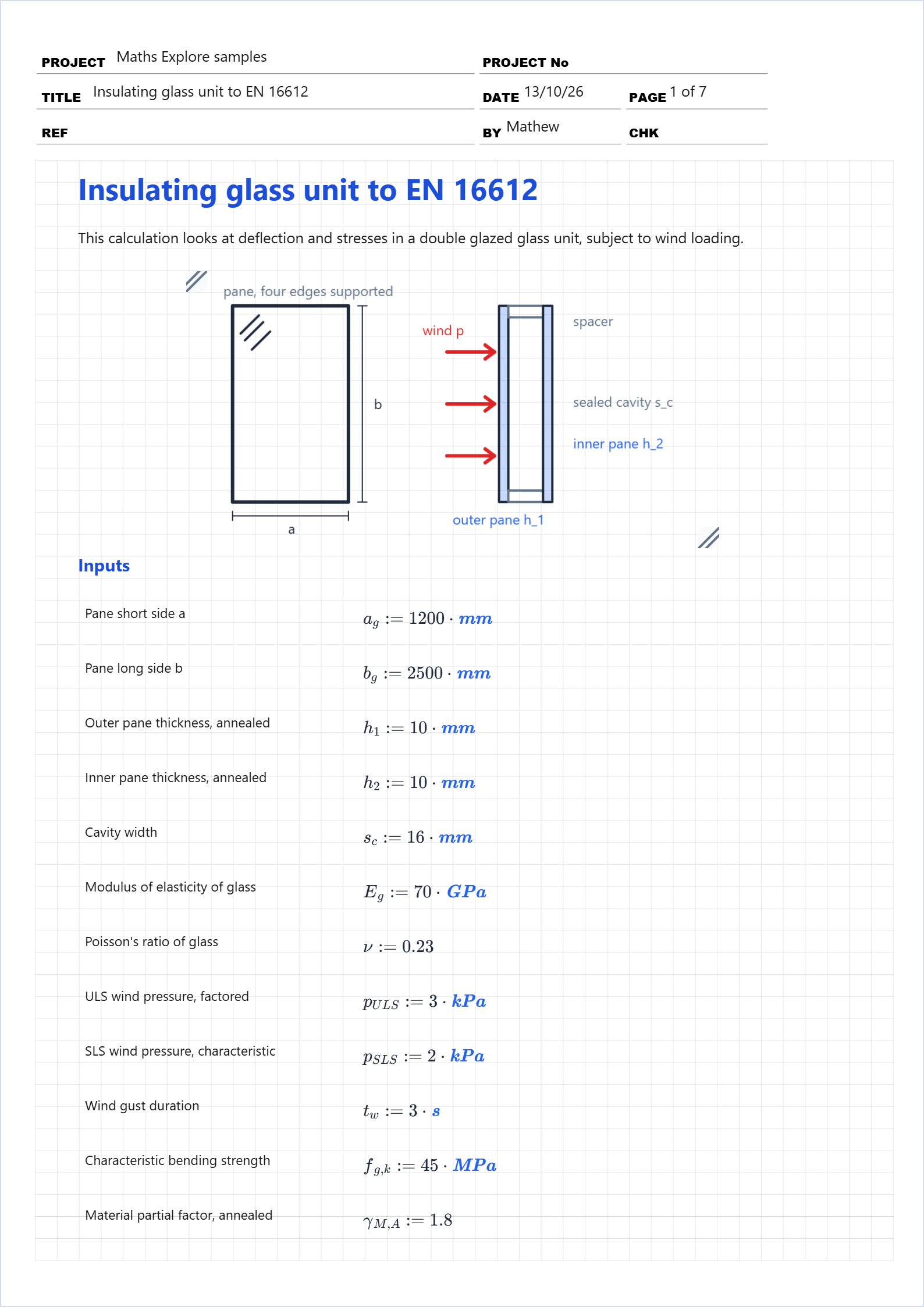
Inputs
- Pane short side a
- Pane long side b
- Outer pane thickness, annealed
- Inner pane thickness, annealed
- Cavity width
- Modulus of elasticity of glass
- Poisson's ratio of glass
- ULS wind pressure, factored
- SLS wind pressure, characteristic
- Wind gust duration
- Characteristic bending strength
- Material partial factor, annealed
The bending stress and deflections coefficients
Annex B include coefficients for deflection and maximum tension stresses in a single glass pane supported on four sides. These coefficients describe fitted curves that capture effects of large out-of-plane deformations, relative to the glass thickness.
- Fit z₂, printed beneath Table B.1
- Fit z₃, printed beneath Table B.1
- Fit z₄, printed beneath Table B.1
- Stress coefficient k₁(λ, p*), Table B.1
- Fit z₁, printed beneath Table B.2
- Deflection coefficient k₄(λ, p*), Table B.2
- Volume coefficient k₅ at p* = 0, Table B.3
- Non-dimensional load p*(h, F_d), Annex B
Characteristic geometry and stiffness shares
- Aspect ratio, short over long side
- a is the shorter side, as the formulas need
- Pane area
- Stiffness share of the outer pane
- Stiffness share of the inner pane
Load sharing through the sealed cavity
EN 16612 Annex C describes how wind load is shared between the front and rear panes in the unit. The gas in the hermetically sealed cavity acts like a spring.
- Characteristic length of the unit, EN 16612 Annex C
- Insulating unit factor
- ULS pressure carried by the outer pane
- ULS pressure carried by the inner pane
- The two shares make up the whole wind
- SLS pressure carried by the outer pane
- SLS pressure carried by the inner pane
Bending stress
The bending stress induced by the ULS wind is checked against the glass's capacity.
- Non-dimensional load, outer pane (ULS)
- Stress coefficient, outer pane
- Maximum bending stress, outer pane (ULS)
- Non-dimensional load, inner pane (ULS)
- Stress coefficient, inner pane
- Maximum bending stress, inner pane (ULS)
- Edge strength factor, four edges supported
- Surface profile factor, float glass
Design bending strength
EN 16612 builds the design strength of annealed glass from its characteristic bending strength and three factors.
- Load duration factor by the formula, t in hours
- Load duration factor adopted, not above 1.0
- Design bending strength, annealed glass
- Outer pane: stress within the design strength
- Inner pane: stress within the design strength
- Strength utilisation, governing pane
Deflection
Deflections are checked under the SLS wind, each pane under its own share. Deflection limits vary but span/65 is fairly common.
- Non-dimensional load, outer pane (SLS)
- Deflection coefficient, outer pane
- Centre deflection, outer pane (SLS)
- Non-dimensional load, inner pane (SLS)
- Deflection coefficient, inner pane
- Centre deflection, inner pane (SLS)
- Deflection limit, short span over 65
- Outer pane within the deflection limit
- Inner pane within the deflection limit
- Deflection utilisation, governing pane