Inputs
- Reservoir level above the basin floor
- Spillway crest above the basin floor
- Width of crest, chute and basin
- Ogee crest discharge coefficient
- Flow-path length of the chute, crest to toe
- Darcy friction factor of the concrete chute
- Density of water
Discharge over the crest
The ogee crest acts as a weir: the discharge grows with the head over the crest to the power 3/2. The flow passes through the critical depth close to the crest, which is the depth and velocity the first reach starts from.
- Head over the crest
- Discharge over the crest
- Discharge per unit width
- Critical depth, taken as the depth at the crest
- Velocity at the crest
The chute, in three reaches
The chute is split into three reaches of equal length. In each, the energy equation is written between its two ends — bed level, plus the depth measured normal to the bed (y·cos θ), plus the velocity head — with the Darcy–Weisbach friction loss taken at the mean of the friction slopes at the two ends: the standard-step method. That loss depends on the unknown downstream depth, so each reach's balance is solved implicitly with root().
- Chute inclination to the horizontal
- Length of each reach
- Bed drop over each reach
- Mean velocity at depth y
- Hydraulic radius at depth y
Friction slope and energy at a station
- Friction slope at depth y
- Energy head at bed level z and depth y
Reach 1: from the crest
- Energy balance of reach 1, zero at its end depth
- Depth at the end of reach 1
- Friction loss in reach 1
- Energy head at the end of reach 1
Reach 2
- Energy balance of reach 2, zero at its end depth
- Depth at the end of reach 2
- Friction loss in reach 2
- Energy head at the end of reach 2
Reach 3: to the toe
- Energy balance of reach 3, zero at its end depth
- Depth at the end of reach 3
- Friction loss in reach 3
- Energy head at the end of reach 3
The three reaches side by side
Collected as vectors: the depth and velocity at the end of each reach, and the loss in each. The flow keeps accelerating down the chute, so most of the loss falls in the last reach — judging the whole chute by its toe velocity alone would roughly double the total.
- Depth at the end of each reach
- Velocity at the end of each reach
- Friction loss in each reach
- Friction loss along the whole chute
- Same loss from the toe velocity alone
The jump in the basin
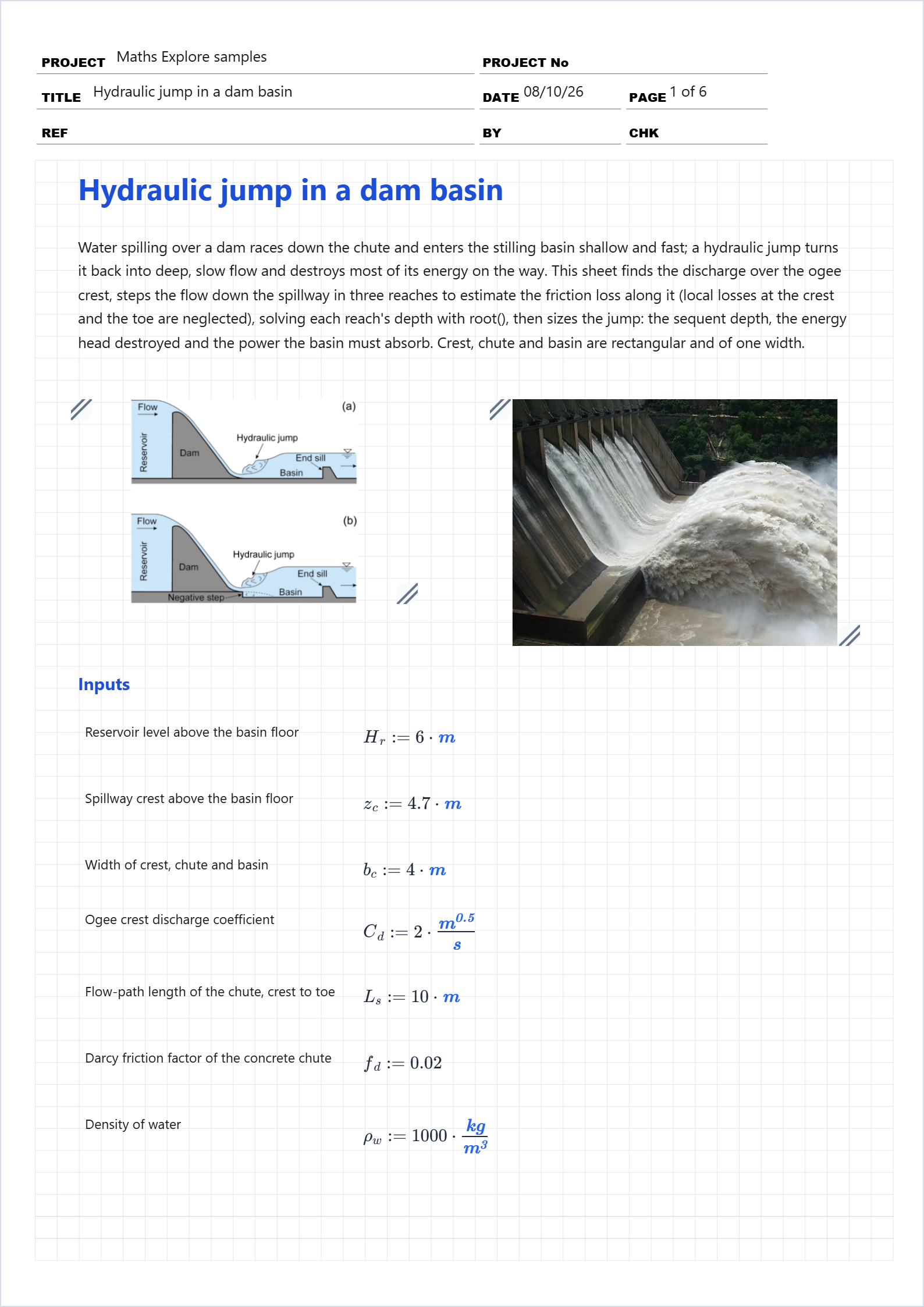
The toe depth and velocity are the jump's upstream conditions. For a rectangular channel the momentum equation gives the depth after the jump from the upstream Froude number (the Bélanger equation); a jump forms only if the entering flow is supercritical.
- Depth entering the basin
- Velocity entering the basin
- Froude number at velocity u and depth y
- Froude number entering the basin
- Supercritical entry, so a jump forms
- Sequent depth after the jump
- Velocity after the jump
- Subcritical after the jump
- Basin length the jump needs, about 6·y₂
- Steady-jump range, lower bound
- Steady-jump range, upper bound
Energy destroyed in the jump
- Specific energy entering the basin
- Specific energy after the jump
- Energy head destroyed by the jump
- Matches the closed-form jump loss
- Share of the entering energy destroyed
- Power dissipated in the basin