
Maths Explore

Maths · sample calcsheet · 2 pages

Turning points with symbolic maths

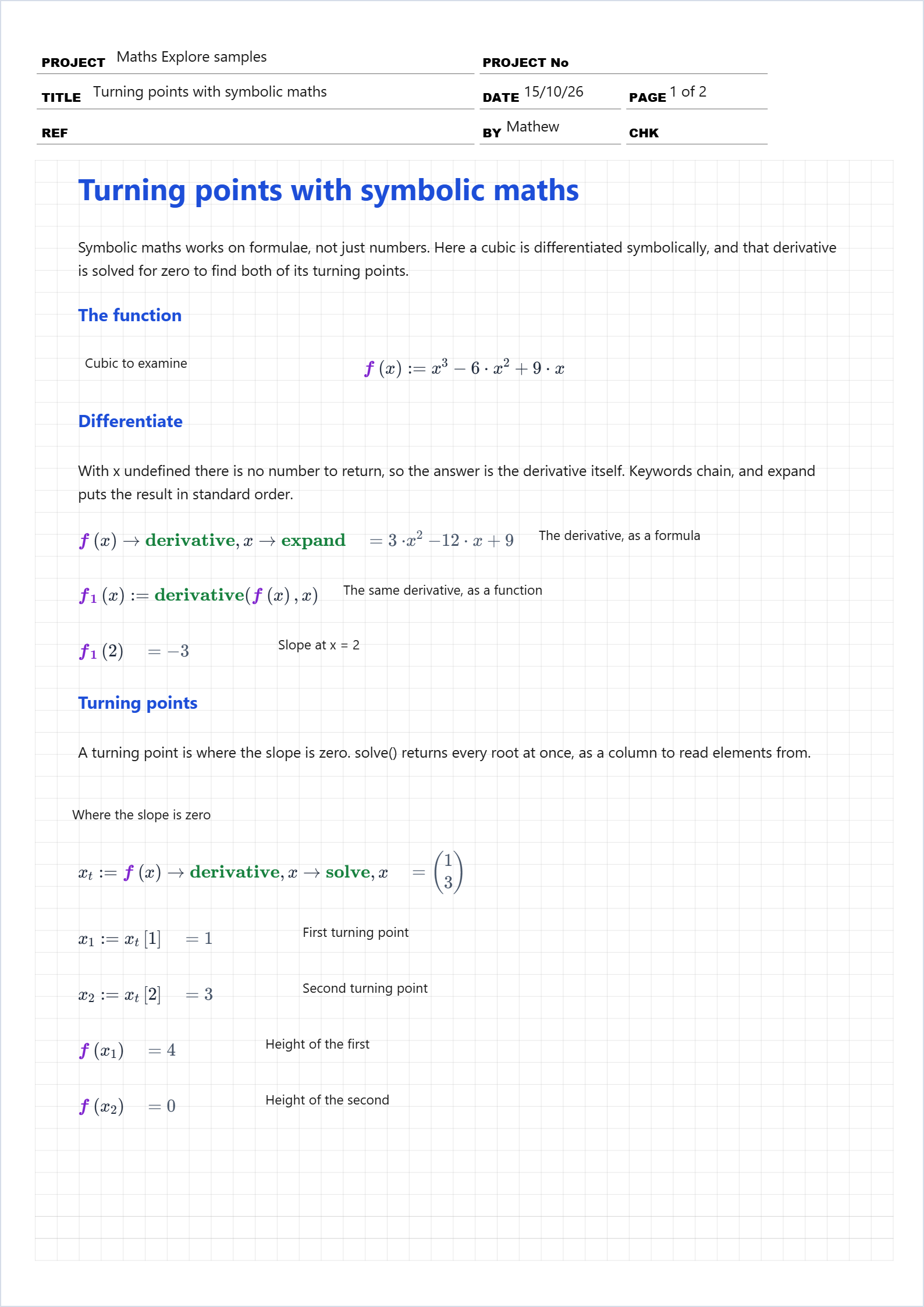
Symbolic maths works on formulae, not just numbers. Here a cubic is differentiated symbolically, and that derivative is solved for zero to find both of its turning points.
First page of the Turning points with symbolic maths sample calcsheet in Maths Explore
The first page of the calcsheet as it appears in Maths Explore.

What this calculation covers

The function

  • Cubic to examine

Differentiate

With x undefined there is no number to return, so the answer is the derivative itself. Keywords chain, and expand puts the result in standard order.

  • The derivative, as a formula
  • The same derivative, as a function
  • Slope at x = 2

Turning points

A turning point is where the slope is zero. solve() returns every root at once, as a column to read elements from.

  • Where the slope is zero
  • First turning point
  • Second turning point
  • Height of the first
  • Height of the second

Maximum or minimum

  • Second derivative, from the first
  • Negative, so a maximum
  • Positive, so a minimum
  • Slope zero at the maximum
  • Slope zero at the minimum

Results summary

  • The cubic turns at x = 1, a maximum of 4, and at x = 3, a minimum of 0. Nothing was differentiated by hand: change the function and every row follows.

Try changing…

  • Set the cubic to x³ − 12x — the turning points move to −2 and 2, and every row below follows.
  • Right-click the derivative row and pick Show as Function Call — the spelling changes, the answer does not.
  • Drop the → expand from the derivative row — the same formula returns, just not in standard order.

All samples