
Maths Explore

Electrical · worked example · 3 pages

Cable voltage drop and power loss

A single-phase 230 V final subcircuit feeds a 32 A load at the end of a long run. Current flows out on the active and back on the neutral, so the circuit resistance uses TWICE the route length. Resistivity is taken at the conductor's operating temperature. Three copper sizes are compared against a 5% drop limit (a common practice figure; the current-carrying capacity, protection and full AS/NZS 3008 assessment are separate exercises this sheet does not replace).

Open this example in Maths Explore

No account needed. Change any input and every result below it updates.
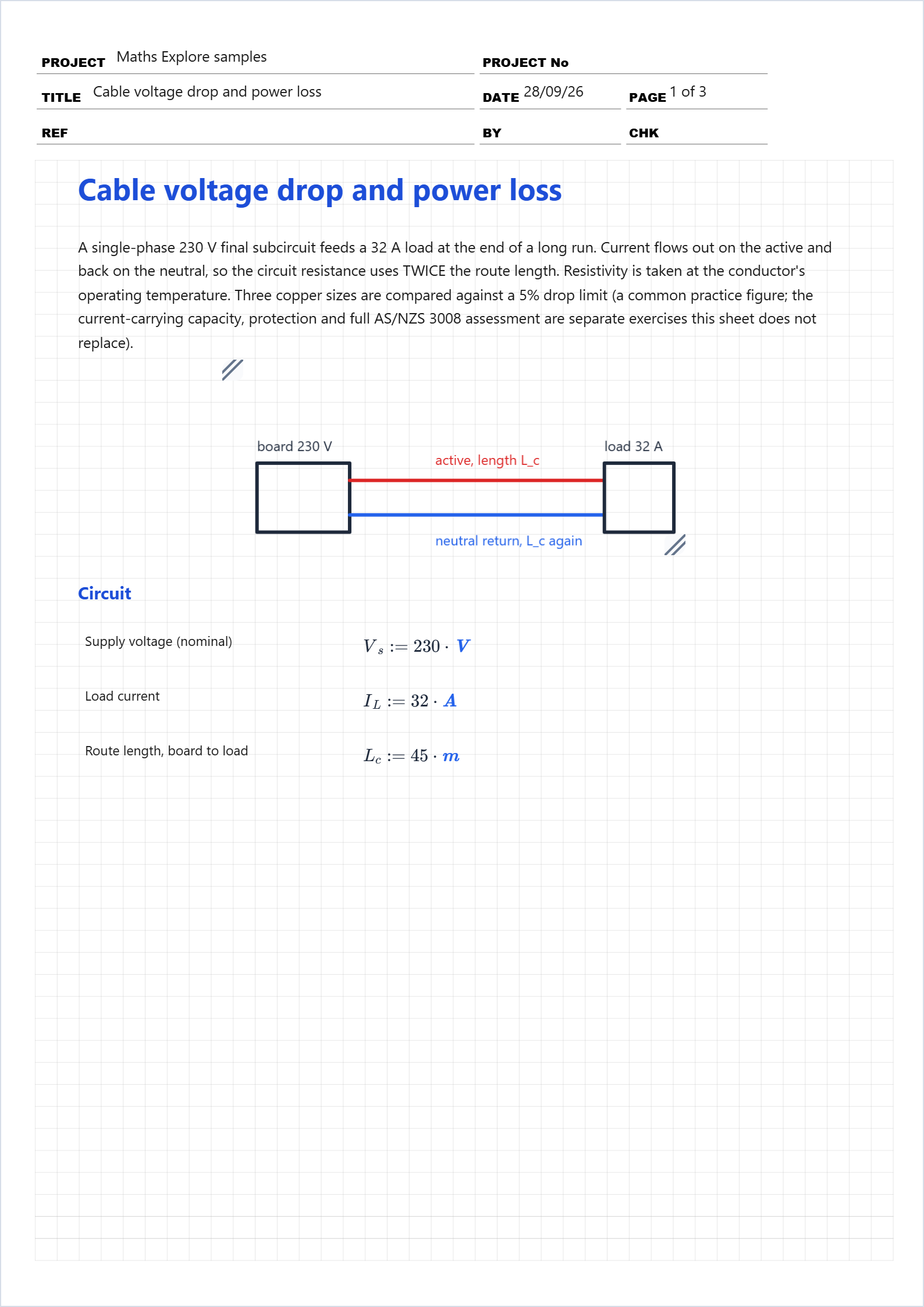
First page of the Cable voltage drop and power loss worked example in Maths Explore
The first page of the calcsheet as it appears in Maths Explore.

What this calculation covers

Circuit

  • Supply voltage (nominal)
  • Load current
  • Route length, board to load
  • Copper resistivity at 20 °C
  • Temperature coefficient of copper
  • Conductor operating temperature
  • Voltage drop limit (practice)
  • Resistivity at operating temperature

Drop and loss as functions of conductor area

  • Circuit resistance, out and back
  • Voltage drop at full load
  • Drop as a share of supply
  • Power lost heating the cable

The 6 mm² candidate

  • Drop at full load
  • As a share of 230 V
  • Inside the 5% limit
  • Voltage delivered to the load
  • Heat lost in the run

Larger sizes for comparison

  • 10 mm² drop share
  • 16 mm² drop share
  • 16 mm² heat loss
  • Would 4 mm² pass? (it should not)

Results summary

  • At 75 °C the 90 m of conductor (45 m out, 45 m back) gives the 6 mm² run 0.319 Ω: a 10.2 V (4.4%) drop, 220 V delivered and 327 W of cable heating at full load. 10 mm² brings the drop to 2.7% and roughly 130 W less heat; 4 mm² fails the limit. Voltage drop often selects the size long before ampacity does on runs like this.

Try changing…

  • Halve the route to 22.5 m — drop and loss halve; 4 mm² would then pass the 5% line.
  • Model a cold start at 20 °C — resistance falls 18% and the drop eases accordingly.
  • Feed at 400 V two-phase-to-neutral? Different circuit entirely — the model here is single-phase only.

All worked examples