
Maths Explore

Mechanical · worked example · 4 pages

Geared motor driving a winch

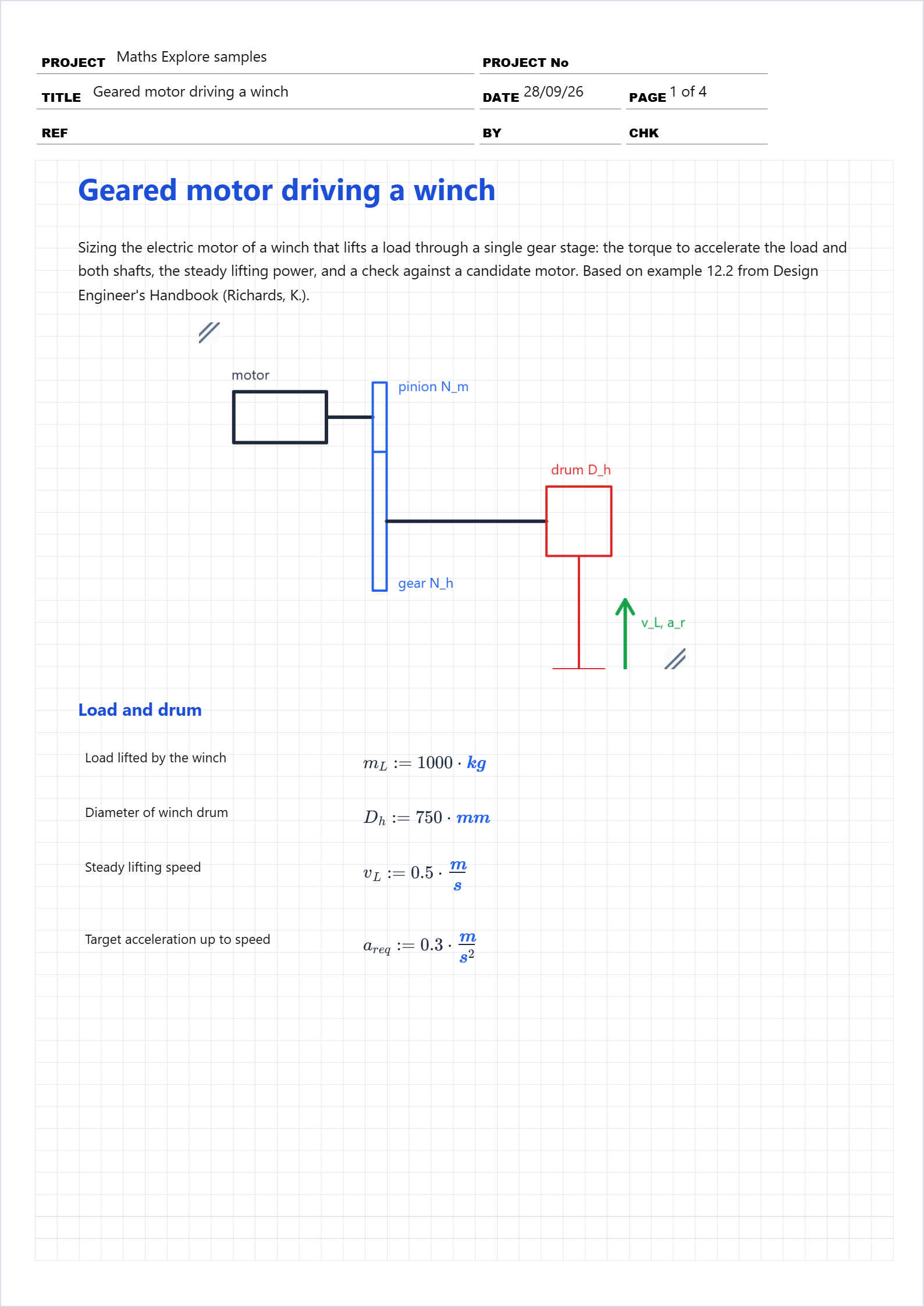
Sizing the electric motor of a winch that lifts a load through a single gear stage: the torque to accelerate the load and both shafts, the steady lifting power, and a check against a candidate motor. Based on example 12.2 from Design Engineer's Handbook (Richards, K.).

Open this example in Maths Explore

No account needed. Change any input and every result below it updates.
First page of the Geared motor driving a winch worked example in Maths Explore
The first page of the calcsheet as it appears in Maths Explore.

What this calculation covers

Load and drum

  • Load lifted by the winch
  • Diameter of winch drum
  • Steady lifting speed
  • Target acceleration up to speed

Machine and gearing

  • Mass of motor shaft assembly
  • Motor shaft radius of gyration
  • Mass of drum shaft assembly
  • Drum shaft radius of gyration
  • Number of teeth on the motor gear
  • Number of teeth on the drum gear
  • Gear stage efficiency
  • Gear ratio (drum rev per motor rev)

Lifting force and drum torque

Two demands to keep apart: holding-and-lifting at constant speed takes gravity only; getting up to speed briefly adds the acceleration force on top.

  • Standard gravity (from the constants sheet)
  • Steady force to lift the load
  • Steady torque at the winch drum
  • Force while accelerating the load
  • Drum torque while accelerating

Referred inertia and motor torque

  • Motor shaft inertia
  • Drum shaft inertia
  • Equivalent inertia at the motor
  • Motor angular acceleration
  • Torque to accelerate the inertias
  • Steady motor torque (gravity only)
  • Peak motor torque while accelerating

Speed and power

  • Motor speed at the lifting speed
  • Motor speed in revolutions per minute
  • Steady lifting power at the motor

Motor capacity check

  • Candidate motor rated torque
  • Candidate motor rated power
  • Peak torque within the motor rating
  • Steady power within the motor rating
  • Torque utilisation (peak)

Comparing a second gear ratio

Peak torque as a reusable function of the ratio (steady power is ratio-independent).

  • Peak motor torque for a ratio n
  • The chosen 10:1 ratio
  • An 8:1 alternative (N_h = 160)

Results summary

  • Steady lifting at 0.5 m/s (127 rpm at the motor) is a gravity-only demand: about 409 N·m and 5.45 kW. Getting up to speed briefly needs about 450 N·m of peak torque. The 500 N·m / 5.5 kW candidate passes both checks — 90% of its torque at the peak, 99% of its power steadily; the 8:1 alternative peaks near 553 N·m and fails the torque rating.

Try changing…

  • Halve a_req — T_req falls toward the steady 409 N·m; T_ss and P_ss do not move.
  • Raise v_L to 0.6 m/s — steady power grows in proportion and fails the 5.5 kW rating.
  • Set the efficiency to 100% — referred inertia and steady torque both drop a tenth.

All worked examples