
Maths Explore

Process · worked example · 3 pages

Batch mixing and dilution

Diluting a concentrate to a working-strength batch: how much concentrate and water make the target mass, checked by a mass balance on the active ingredient. Every concentration here is BY MASS (w/w) — mixing that up with by-volume (v/v) figures is the classic dilution error, and the density rows show why the two differ.

Open this example in Maths Explore

No account needed. Change any input and every result below it updates.
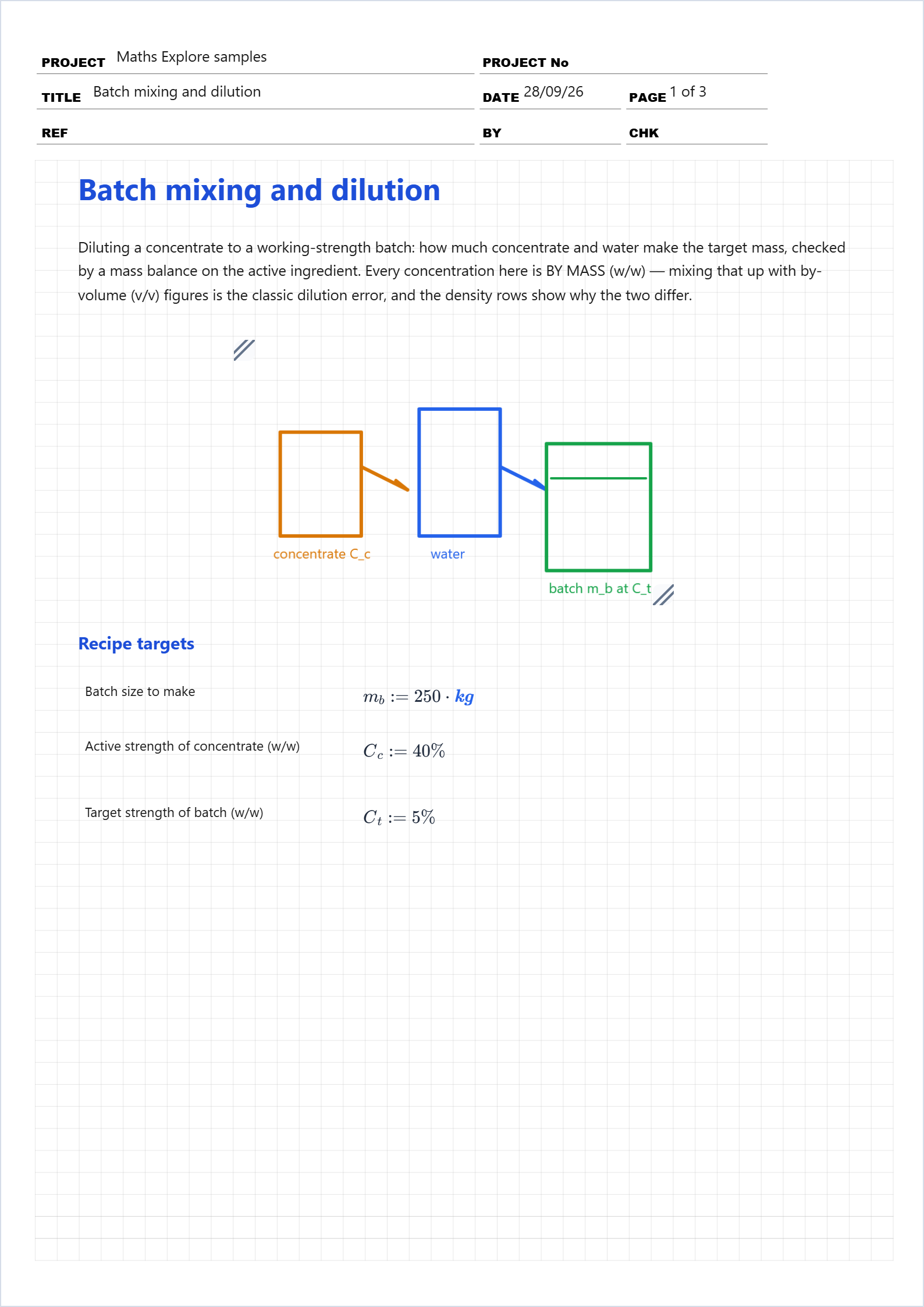
First page of the Batch mixing and dilution worked example in Maths Explore
The first page of the calcsheet as it appears in Maths Explore.

What this calculation covers

Recipe targets

  • Batch size to make
  • Active strength of concentrate (w/w)
  • Target strength of batch (w/w)
  • Concentrate density (example)
  • Water density

Masses to weigh out

The active ingredient all comes from the concentrate, so the batch's active mass fixes the concentrate mass directly.

  • Concentrate to weigh in
  • Dilution water to add
  • Active ingredient in the batch

Mass-balance checks

  • Total mass closes
  • Active mass hits the target strength

Volumes for the measuring jugs

Note the mismatch: 12.5% of the batch's mass is concentrate by weight of jug — but only 11.5% of its volume, because the concentrate is denser than water. A v/v recipe is a different recipe.

  • Concentrate by volume
  • Water by volume

Scaling the recipe

  • Concentrate for a batch of mass m
  • Water for a batch of mass m
  • Concentrate for a 400 kg batch
  • Water for a 400 kg batch

Results summary

  • A 250 kg batch at 5% w/w takes 31.25 kg of the 40% concentrate (28.4 L) and 218.75 kg of water (219.2 L); both balances close exactly. The functions scale any batch size in one line — 400 kg needs 50 kg and 350 kg respectively.

Try changing…

  • Use a 32% concentrate — the concentrate mass rises a quarter and the water shrinks to match.
  • Ask for 8% strength — concentrate scales up in direct proportion (50 kg for this batch).
  • Set C_t above C_c — the water mass goes negative: dilution cannot concentrate.

All worked examples