
Maths Explore

Facade · worked example · 3 pages

Facade panel and supporting mullion

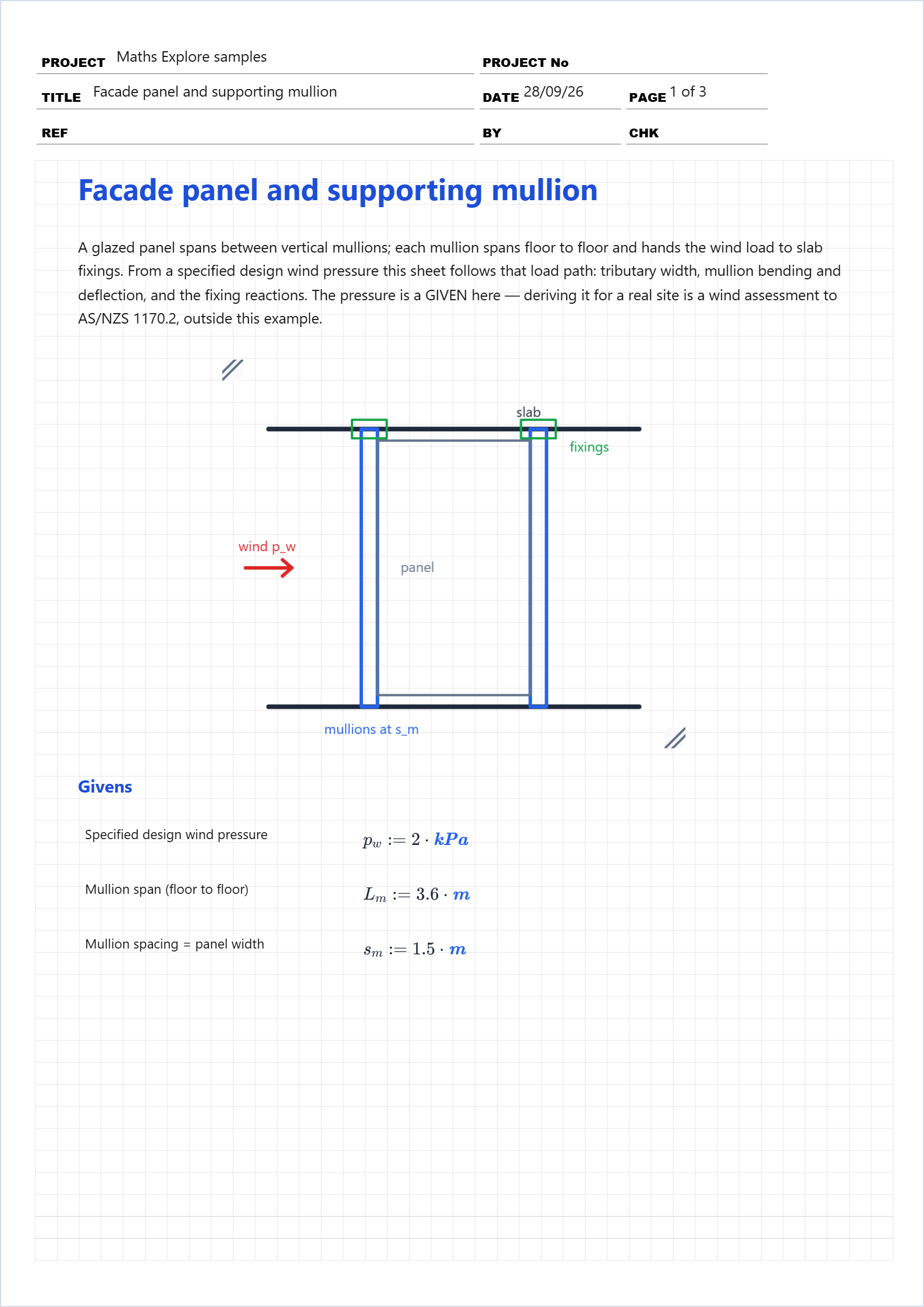
A glazed panel spans between vertical mullions; each mullion spans floor to floor and hands the wind load to slab fixings. From a specified design wind pressure this sheet follows that load path: tributary width, mullion bending and deflection, and the fixing reactions. The pressure is a GIVEN here — deriving it for a real site is a wind assessment to AS/NZS 1170.2, outside this example.

Open this example in Maths Explore

No account needed. Change any input and every result below it updates.

First page of the Facade panel and supporting mullion worked example in Maths Explore
The first page of the calcsheet as it appears in Maths Explore.

What this calculation covers

Givens

  • Specified design wind pressure
  • Mullion span (floor to floor)
  • Mullion spacing = panel width
  • Mullion second moment (catalogue)
  • Mullion section modulus (catalogue)
  • Aluminium elastic modulus
  • Limit stress, 6063-T6 (example)
  • Capacity factor (example)

Load path: panel to mullion

Each mullion carries half a panel each side — one full panel width of wind.

  • Tributary area per mullion span
  • Line load on one mullion
  • Total wind force per mullion span

Mullion bending and deflection

  • Midspan bending moment
  • Design bending capacity
  • Mullion strength adequate
  • Midspan deflection
  • Facade deflection limit L/175
  • Deflection within limit

Fixing loads

  • Reaction at each floor fixing
  • Force per anchor (two per bracket)

A shallower mullion for comparison

  • Deflection for a mullion with second moment I
  • Shallower section (I = 4×10⁶ mm⁴)
  • Shallower mullion passes?

Results summary

  • At 2 kPa each mullion carries 10.8 kN of wind: 4.86 kN·m of bending (60% of capacity) and 15.6 mm of deflection against a 20.6 mm L/175 limit. Each floor bracket must resist 5.4 kN. The shallower 4×10⁶ mm⁴ mullion deflects 23.4 mm and fails serviceability — stiffness, not strength, sizes the section.

Try changing…

  • Widen the spacing to 1.8 m — load, moment and deflection all rise a fifth; deflection nears its limit.
  • Raise the pressure to 2.5 kPa (a suction peak) — deflection reaches 19.5 mm, still inside L/175.
  • Stretch the span to 4.0 m — deflection grows with L⁴ (×1.52 for +11%) and the check fails.

All worked examples