
Maths Explore

Mechanical · worked example · 3 pages

Bolt tightening and preload

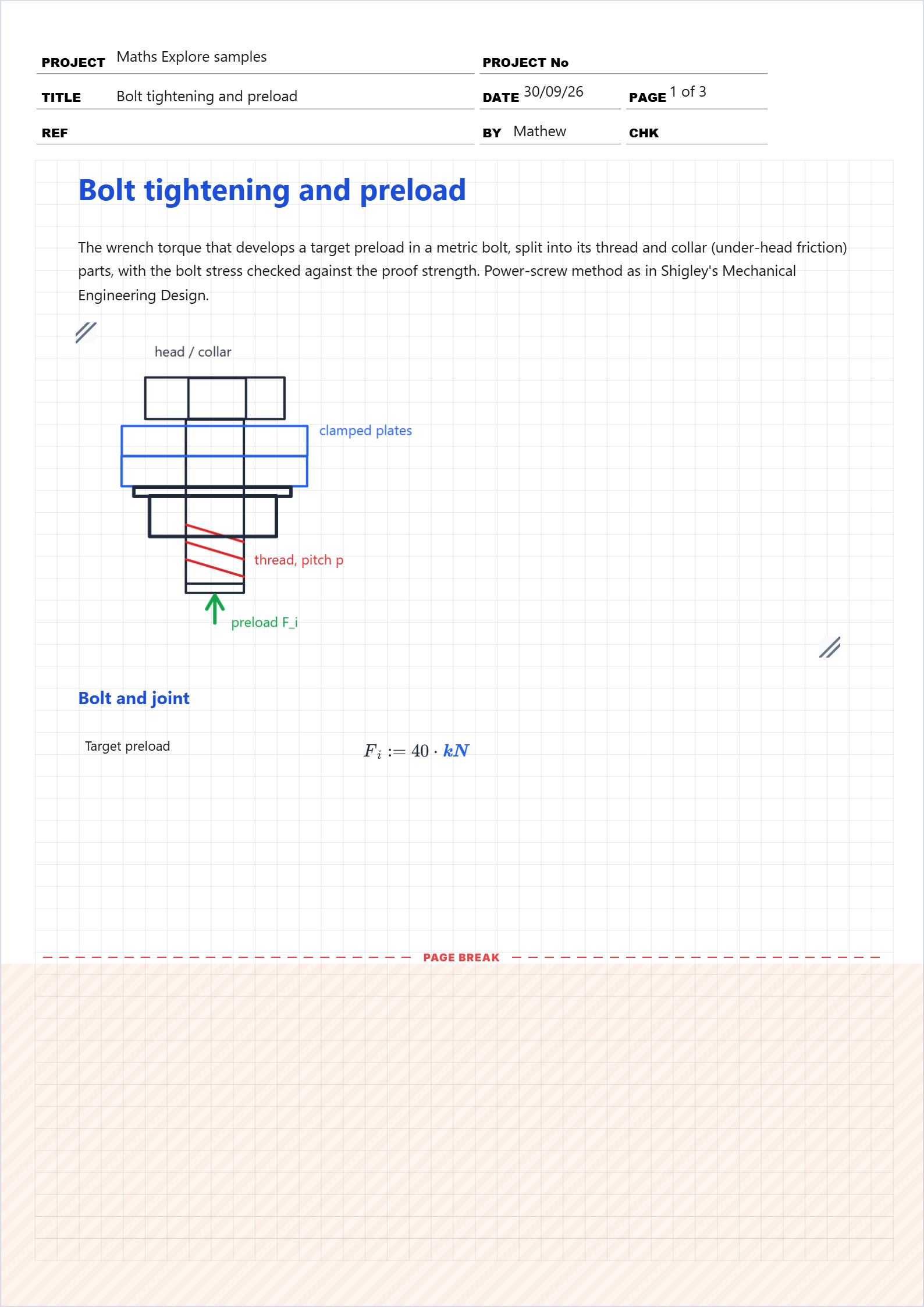
The wrench torque that develops a target preload in a metric bolt, split into its thread and collar (under-head friction) parts, with the bolt stress checked against the proof strength. Power-screw method as in Shigley's Mechanical Engineering Design.

Open this example in Maths Explore

No account needed. Change any input and every result below it updates.

First page of the Bolt tightening and preload worked example in Maths Explore
The first page of the calcsheet as it appears in Maths Explore.

What this calculation covers

Bolt and joint

  • Target preload
  • Nominal bolt diameter (M12)
  • Thread pitch
  • Metric thread half angle
  • Thread friction coefficient
  • Collar friction coefficient
  • Washer face outer diameter
  • Tensile stress area of M12 (ISO 898-1)
  • Proof strength, property class 8.8

Thread geometry

  • Pitch (mean thread) diameter
  • Thread lead angle

Tightening torque

  • Torque carried by the thread
  • Mean collar (washer face) diameter
  • Torque lost to collar friction
  • Wrench torque to apply
  • Equivalent nut factor K

Bolt stress at preload

  • Preload stress in the bolt
  • Share of proof strength used
  • Preload within 90% of proof

How friction moves the answer

Most of the wrench torque is spent on friction, so the assumed coefficients dominate. The same calculation as a function of a single shared coefficient:

  • Wrench torque for friction μ on thread and collar
  • Dry, unlubricated (μ = 0.15)
  • Lightly oiled (μ = 0.10)

Results summary

  • Reaching a 40 kN preload in this dry M12 joint takes about 94 N·m at the wrench (K ≈ 0.20), stressing the bolt to about 82% of its 8.8 proof strength. Oiling the threads drops the needed torque by nearly a third — tightening to 94 N·m when oiled would overload the bolt.

Try changing…

  • Set both friction coefficients to 0.10 — the wrench torque falls to about 66 N·m for the same preload.
  • Raise the preload to 48 kN — stress passes 90% of proof and the check fails.
  • Use an M16 bolt (d, p, A_t from its table row) — torque rises with diameter even at the same preload.

All worked examples