
Maths Explore

Hydraulics · worked example · 4 pages

Pumping water between two tanks

The motor power needed to pump water up to a header tank: velocity from the flow, friction from the Darcy–Weisbach equation with an explicit Swamee–Jain friction factor (no iteration needed), fitting losses from K-values, then hydraulic and shaft power. Two pipe bores are compared. Valid for turbulent flow (Re > 4000), which the sheet checks.

Open this example in Maths Explore

No account needed. Change any input and every result below it updates.
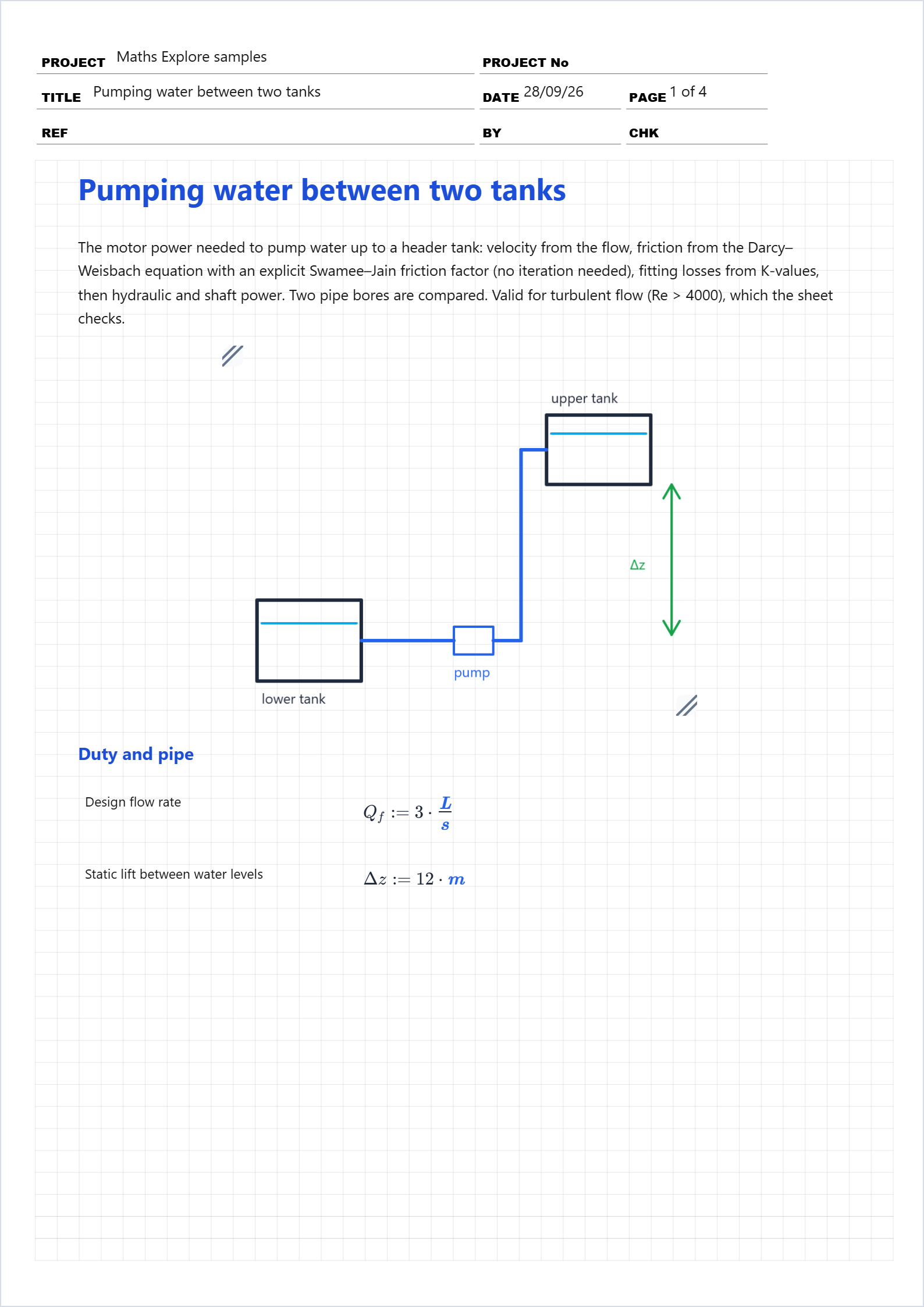
First page of the Pumping water between two tanks worked example in Maths Explore
The first page of the calcsheet as it appears in Maths Explore.

What this calculation covers

Duty and pipe

  • Design flow rate
  • Static lift between water levels
  • Pipe length, suction to discharge
  • Pipe internal diameter (DN50 PE)
  • Pipe roughness (PE, example)
  • Water density (20 °C)
  • Kinematic viscosity (20 °C)
  • Sum of fitting K-values
  • Gravity

Velocity and flow regime, as functions of bore

  • Mean velocity in a bore d
  • Reynolds number in a bore d
  • Velocity in the DN50 pipe
  • Velocity within the usual 3 m/s guide
  • Reynolds number, DN50
  • Turbulent, so the friction model applies

Friction and total head

  • Swamee–Jain explicit friction factor
  • Pipe friction head for a bore d
  • Fitting losses for a bore d
  • Total pumping head for a bore d
  • Friction factor, DN50
  • Total head, DN50

Power

  • Pump efficiency at duty (example)
  • Motor sizing margin
  • Hydraulic (water) power
  • Shaft power into the pump
  • Motor power to specify

A smaller bore for comparison

  • Velocity in DN40
  • Total head with DN40 pipe
  • Shaft power with DN40 pipe

Results summary

  • Through DN50 pipe the duty is 3 L/s against 14.5 m of head (12 m static + 2.5 m of losses): 427 W of water power, 712 W at the shaft, so a 0.75–1.1 kW motor with the 15% margin. Dropping to DN40 raises the losses to 7.1 m and the shaft power by almost a third — pipe bore is usually cheaper than pump power.

Try changing…

  • Double the flow to 6 L/s — friction losses quadruple (v²) and the DN50 velocity check fails.
  • Use rough steel (ε = 0.045 mm) — the friction factor climbs about a tenth on this duty.
  • Set Δz to 0 — head is pure friction; compare how the two bores then differ fourfold.

All worked examples