
Maths Explore

Mechanical · worked example · 4 pages

Vehicle braking on a slope

Stopping distance on a downhill grade, split into thinking and braking parts. Braking model: constant deceleration at the friction limit, a = g(μ·cosθ − sinθ) — full grip on every wheel, uniform μ, no aerodynamics, no load transfer, level of a simple hand check rather than a reconstruction. Downhill, gravity steals part of the grip; the sheet flags when none is left.

Open this example in Maths Explore

No account needed. Change any input and every result below it updates.
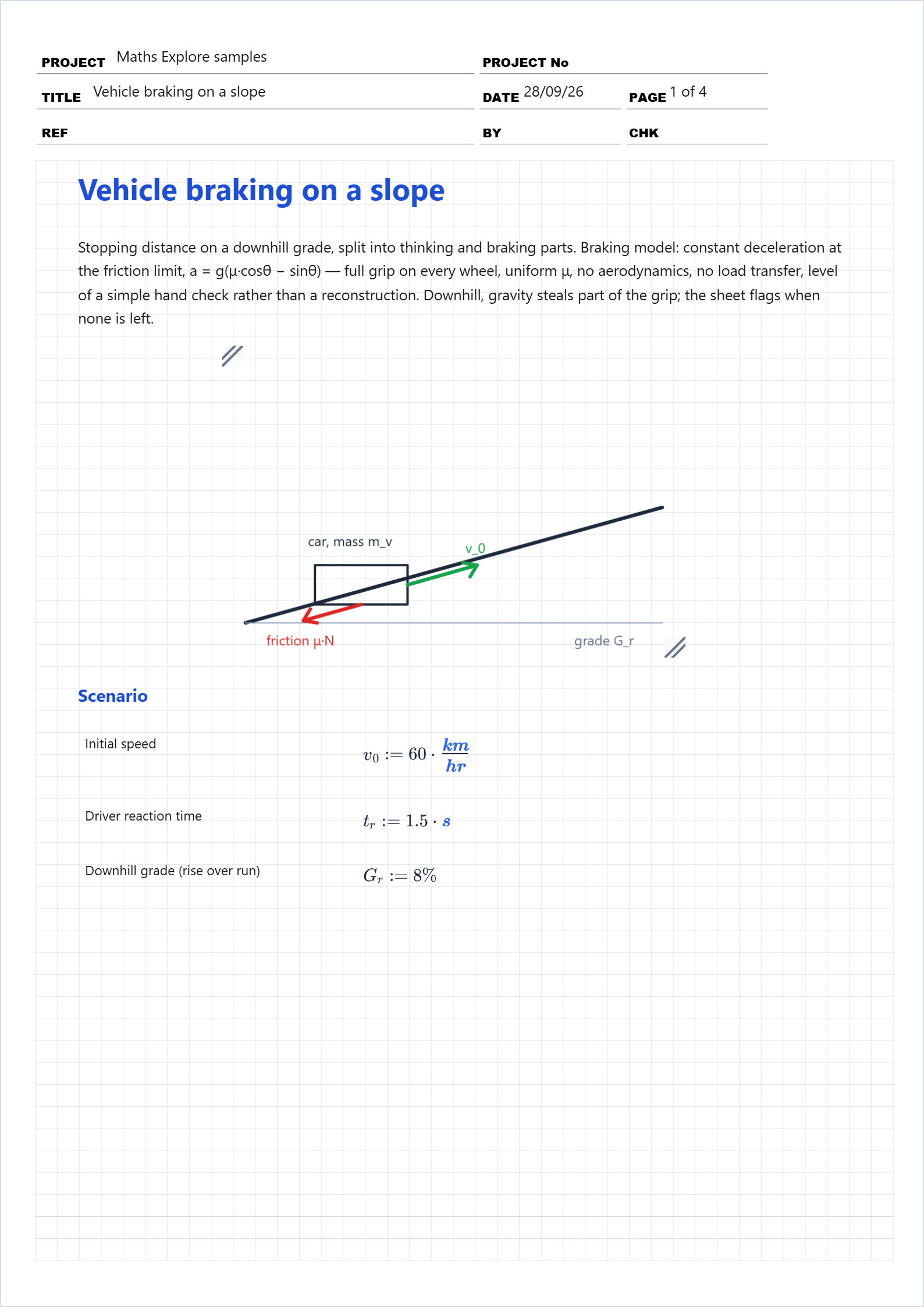
First page of the Vehicle braking on a slope worked example in Maths Explore
The first page of the calcsheet as it appears in Maths Explore.

What this calculation covers

Scenario

  • Initial speed
  • Driver reaction time
  • Downhill grade (rise over run)
  • Tyre-road friction, dry (example)
  • Vehicle mass
  • Slope angle from the grade
  • Standard gravity (from the constants sheet)

Deceleration at the friction limit

  • Available deceleration on the grade
  • 1 while friction beats gravity (0 = runaway)

Stopping distance and time

  • Distance covered while reacting
  • Braking distance
  • Total stopping distance
  • Total stopping time

What the brakes must turn into heat

The kinetic energy is only the speed's share. Going downhill the car also descends while braking, so gravity keeps feeding energy in over the braking distance — the brakes dissipate both. Uphill the sign flips and gravity helps.

  • Initial kinetic energy at v₀
  • Gravity's work during the braking distance
  • Total heat the brakes dissipate

A reusable stopping-distance function

  • Stopping distance for speed v, grade G, friction μ
  • 50 km/h, this hill, dry
  • 70 km/h, this hill, dry
  • 60 km/h on the flat
  • 60 km/h here, wet (μ = 0.35)

Results summary

  • From 60 km/h on the 8% descent a dry stop takes about 48 m — 25 m of it before the brakes even bite — and 4.3 s. The brakes dissipate about 235 kJ: 208 kJ of speed plus 27 kJ gravity adds during the descent. Ten km/h more adds a quarter to the distance; rain nearly doubles the braking part. The model's limits (constant μ, no aero, instant full braking) all err on the simple side: treat results as comparisons, not predictions.

Try changing…

  • Set the grade to −8% (uphill) — gravity now helps and the braking distance shortens by a third.
  • Push μ down toward tanθ (≈ 0.08 here) — a_b heads to zero, the distances blow up, ok_g flips to 0.
  • Halve the reaction time — 12.5 m saved regardless of grip; attention beats tyres at these speeds.

All worked examples