
Maths Explore

Thermal · worked example · 3 pages

Heat exchanger sizing

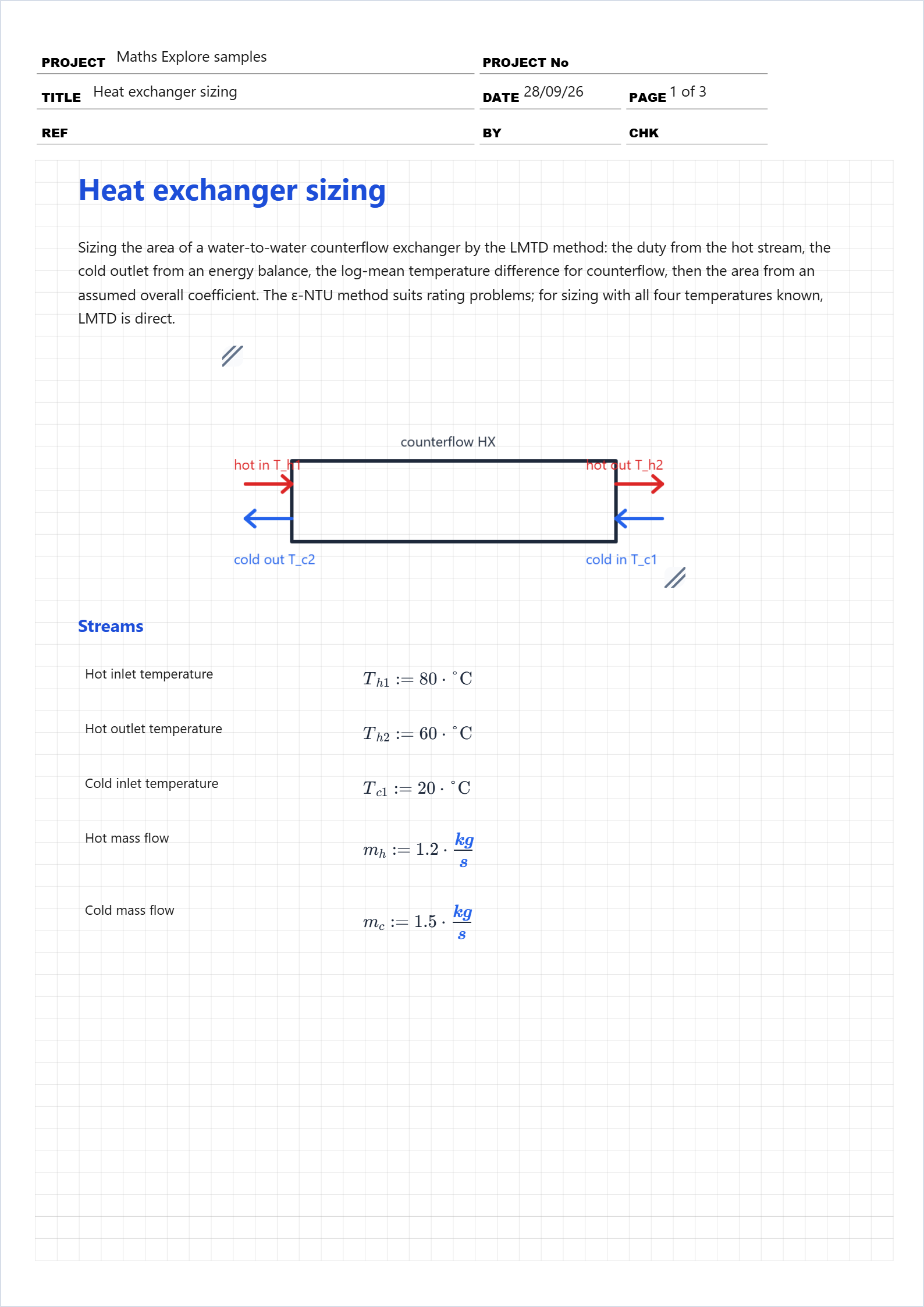
Sizing the area of a water-to-water counterflow exchanger by the LMTD method: the duty from the hot stream, the cold outlet from an energy balance, the log-mean temperature difference for counterflow, then the area from an assumed overall coefficient. The ε-NTU method suits rating problems; for sizing with all four temperatures known, LMTD is direct.

Open this example in Maths Explore

No account needed. Change any input and every result below it updates.
First page of the Heat exchanger sizing worked example in Maths Explore
The first page of the calcsheet as it appears in Maths Explore.

What this calculation covers

Streams

  • Hot inlet temperature
  • Hot outlet temperature
  • Cold inlet temperature
  • Hot mass flow
  • Cold mass flow
  • Specific heat of water (~50 °C)
  • Overall coefficient, clean plate HX

Duty and the cold outlet

  • Heat duty from the hot stream
  • Cold outlet from the energy balance
  • Heat picked up by the cold stream
  • Energy balance closes

Log-mean temperature difference (counterflow)

The differences carry °C tags; dividing each by K first makes the log-mean come out as a plain kelvin difference. When the two ends are (near) equal the log-mean formula becomes 0/0 — its limit is simply that common value, so the calculation switches to the arithmetic mean there.

  • Terminal difference, hot-in end
  • Terminal difference, hot-out end
  • Hot-in end difference, in kelvin
  • Hot-out end difference, in kelvin
  • Log-mean temperature difference (mean at the equal limit)

Required area

  • Heat-transfer area required

Operating comparisons

Parallel flow with the same temperatures would give ΔT ends of 60 K and 24 K — LMTD 39.3 K — needing about 7% more area, and it could never cool the hot stream below the cold outlet.

  • Area needed at an overall coefficient U
  • Fouled service (U = 500)

Results summary

  • Cooling 1.2 kg/s of water from 80 °C to 60 °C is a 100 kW duty that warms the 1.5 kg/s cold stream to 36 °C. With counterflow LMTD of 42 K and U = 850 W/m²K the exchanger needs about 2.8 m² — call it 3 m² with margin; fouling to U = 500 would demand 4.8 m².

Try changing…

  • Halve the cold flow — the cold outlet climbs to 52 °C, ΔT_lm shrinks, and the area grows.
  • Ask for T_h2 = 40 °C — double the duty, tighter approaches, and area more than doubles.
  • Set both flows equal — the terminal differences equalise and LMTD tends to their common value.

All worked examples