
Maths Explore

Thermal · worked example · 3 pages

How long ice lasts in an esky

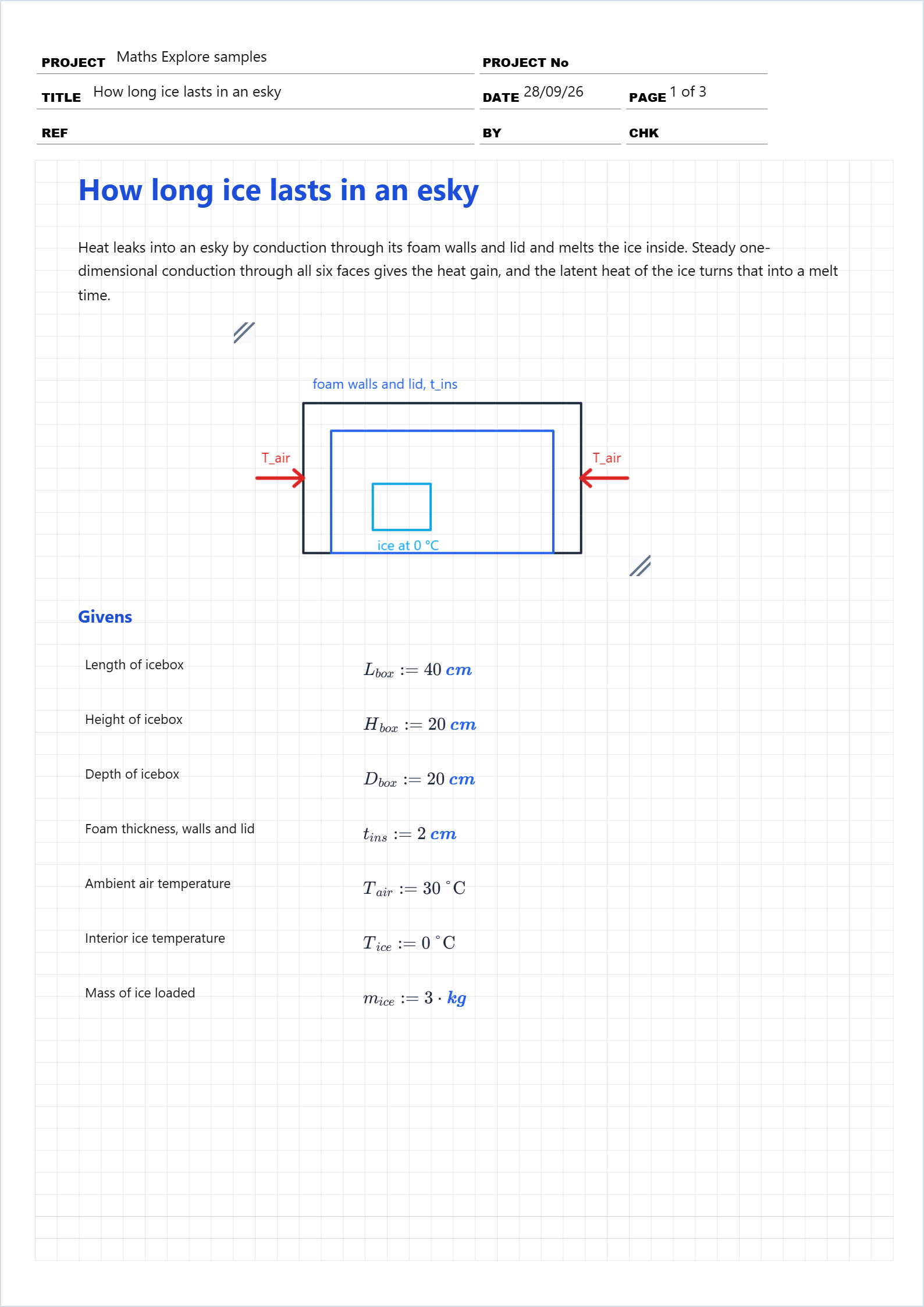
Heat leaks into an esky by conduction through its foam walls and lid and melts the ice inside. Steady one-dimensional conduction through all six faces gives the heat gain, and the latent heat of the ice turns that into a melt time.

Open this example in Maths Explore

No account needed. Change any input and every result below it updates.

First page of the How long ice lasts in an esky worked example in Maths Explore
The first page of the calcsheet as it appears in Maths Explore.

What this calculation covers

Givens

  • Length of icebox
  • Height of icebox
  • Depth of icebox
  • Foam thickness, walls and lid
  • Ambient air temperature
  • Interior ice temperature
  • Mass of ice loaded
  • Latent heat of melting for water
  • Conductivity of polystyrene foam
  • Temperature difference across the foam

Heat gain

All six outer faces conduct; the outer dimensions overstate the area slightly, which is conservative (more heat in).

  • Outer surface area, six faces
  • Rate of heat gain

Melt time

  • Heat that melts all the ice
  • Time until the ice is gone

What if — thicker foam, hotter day

Melt time as a reusable function of foam thickness and ambient temperature:

  • Melt time for wall t_w and ambient T_a
  • As designed
  • Double the foam
  • A 40 °C day

Assumptions

  • Steady conduction through the foam only: air films, seams, radiation and lid openings are ignored.
  • Contents are already at 0 °C, so all the heat goes into melting, none into cooling drinks down.
  • Melt water stays at 0 °C inside; the outer-area estimate is slightly conservative.

Results summary

  • About 17 W leaks in on a 30 °C day, so 3 kg of ice lasts roughly 17 hours. Doubling the foam doubles the time; a 40 °C day cuts it by a quarter.

Try changing…

  • Load 6 kg of ice — the melt time doubles: it scales directly with the mass.
  • Halve every box dimension — area falls faster than contents, and small eskies fare worse per kg.
  • Set T_air to 0 °C — no temperature difference, no heat gain: the melt time heads to infinity.

All worked examples